2025 BRICS Summit: Takeaways and Projections
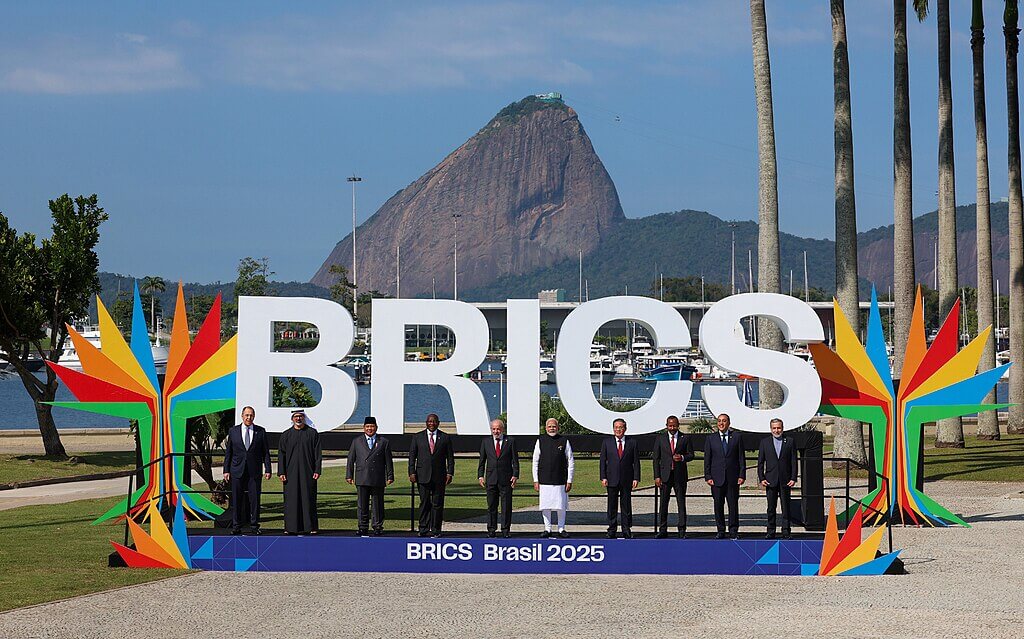
Held July 6-7 in Rio, the BRICS Summit occurred amid global tension and growing fractures in multilateralism.
The Global South in the World Order Project regularly convenes experts from across the Global South to examine pressing international issues that challenge conventional wisdom and introduce non-Western perspectives into key policy debates in Washington. This event was hosted by New America’s Planetary Politics program, where Aude Darnal is currently a visiting fellow. This publication is part of the Global South Experts Turn-the-Tables series, which features insights from selected participants in these discussions.
Editor's Note
David Monyae is the director of the University of Johannesburg Confucius Institute (UJCI) and the Centre for Africa-China Studies (CACS), as well as an associate professor of Political Science & International Relations at the University of Johannesburg, South Africa. He has experience working at development banks across Africa and has written extensively about the BRICS. Notably, Professor Monyae published a book on the topic in 2021: The BRICS Order.
Ana Saggioro Garcia is the general coordinator of the BRICS Policy Center. She is also an assistant professor at the Institute of International Relations (IRI) at the Pontifical Catholic University of Rio de Janeiro (PUC-Rio) and a professor of the graduate program in Social Sciences at the Federal Rural University of Rio de Janeiro. She is a specialist on the BRICS and focuses on the international political economy and South-South relations, among other topics.
Bhima Yudhistira Adhinegara is the executive director of the Center of Economic and Law Studies (CELIOS), an Indonesia-based economic think tank. His expertise in international finance and the energy transition, combined with his deep knowledge of Indonesian foreign policy, provides a nuanced perspective on Indonesia's role as a new BRICS member.
By Aude Darnal, Research Analyst, Reimagining US Grand Strategy
Background
Multilateralism is increasingly fragmented and global policy reform to help Global South countries prosper face significant challenges. BRICS has emerged as a forum for governments seeking alternative solutions and opportunities to advance their interests. Now with 11 member countries, 10 partners, and more states seeking affiliation, the BRICS group presents itself as a platform of choice for countries across the Global South, but it has yet to outline a clear strategy to advance the reforms it purports to promote. This question-and-answer with international affairs experts from Brazil, Indonesia, and South Africa addresses some important questions about the BRICS' current efforts and where the group is heading.
In his opening speech at the 2025 BRICS Summit in Rio de Janeiro, Brazil, Luiz Inácio Lula da Silva, the president of Brazil, painted a bleak picture of current international affairs: “We are witnessing an unprecedented collapse of multilateralism,” he said. Notably, Lula decried the weakening of international law; the renewed threat of nuclear war and growing number of conflicts; and the increase of military spending in the Global North, in contrast to the decrease of official development assistance for the Global South. To address these threats, Lula reiterated his call for global governance reform to revitalize diplomacy, cooperation, and the United Nations (U.N.) system, particularly the U.N. Security Council. For Lula, “If international governance does not reflect the 21st century’s new multipolar reality, it is up to the BRICS to contribute to bringing it up to date.”
In the United States, President Donald Trump has long been antagonistic toward the BRICS. In November 2024, in response to discussions among BRICS members on the weaponization of the dollar and potential efforts toward de-dollarization — a hot topic in the 2024 BRICS Summit — Trump threatened to apply 100% tariffs on the group's members. In this year's BRICS Summit's Joint Declaration, the group avoided mentioning the United States directly, but it voiced "serious concerns about the rise of unilateral tariff and non-tariff measures" and reaffirmed its commitment to strengthening multilateralism, in an attempt to avoid further tensions with the United States. Despite this, in July 2025, the Trump administration threatened the group's members with an additional 10% tariff should they pursue "anti-American policies." Nonetheless, these tensions with Washington have not prevented the BRICS from expanding, with five new members and nine new partner nations joining between October 2024 and January 2025.
In Washington, the dominant narrative focuses on the potential collapsing of the BRICS owing to the diversity of its membership, lack of a practical strategy to advance reform, and concerns about an "anti-U.S. and anti-Global North" agenda. It is paramount for U.S. and Global North policymakers to deconstruct inaccurate assumptions about the majority of BRICS members in order to maintain or strengthen their relations with their BRICS partners because a "stick" strategy will only push them further away. This interview with three experts from Brazil, Indonesia, and South Africa aims to help policy experts in the United States, as well as U.S. allies, deepen their understanding of the different BRICS members, particularly their worldviews and the challenges they face in achieving prosperity. This paper also focuses on how the BRICS view their role in pushing through much-needed reforms and addressing pressing global issues, from climate change to global health and international security.
Q&A
What are your main takeaways from the BRICS Summit that took place in Rio de Janeiro on July 6-7?
David Monyae
The 17th BRICS Summit in Rio de Janeiro reinforced the bloc's commitment to strengthening multilateralism and Global South Cooperation for a more inclusive and sustainable global governance. The leaders of the 11-largest emerging economies signed a Joint Declaration titled "Strengthening Global South Cooperation for More Inclusive and Sustainable Governance." They committed to strengthening multilateralism, defending international law, and striving for a more equitable global order.
New cooperation mechanisms were created or reinforced to achieve goals such as eradicating hunger, tackling climate change, and developing emerging technologies. The summit adopted 126 commitments covering global governance, finance, health, artificial intelligence, climate change, peace and security, and cultural and people-to-people cooperation.
The BRICS members renewed their commitment to serve as a collective voice against global conflicts and wars. The bloc unanimously condemned Israeli and U.S. military strikes inside Iran, as well as Israel's continued war and aggression against Palestinians in Gaza and its repeated violations of the ceasefire agreements with Lebanon. The BRICS also expressed support for peace efforts in Syria, Sudan, and other parts of the world.
Ana Saggioro Garcia
The BRICS Summit in Rio de Janeiro featured, for the first time, three finance-related declarations, in addition to a statement on climate finance. One declaration focused on the demand for a reform of International Monetary Fund (IMF) quotas, including a call to revise the "gentlemen's agreement" on representation at the IMF and the World Bank (which involves appointing a European and an American to lead each institution). In my view, this declaration signals a certain return to the origins of the BRICS, in the context of the 2008 financial crisis, when the bloc's main common agenda was to reform the Bretton Woods institutions1 in order to grant a greater voice and wider participation to the emerging economies of the Global South.
Another declaration addressed taxation. The BRICS countries jointly supported the U.N. Framework Convention on International Tax Cooperation. This convention, ratified in September 2024, is a longstanding demand of developing countries. They argue that tax-related debates should take place within the U.N., which is seen as a more democratic and inclusive forum than the Organisation for Economic Co-operation and Development (OECD). However, there was no explicit mention of taxing ultra-high-net-worth (super rich) individuals — a topic that was a highlight of Brazil's presidency of the G-20 and that was included in the BRICS' Kazan Declaration in 2024.2
The general declaration by finance ministers and central bank governors reinforced the importance of multilateral trade negotiations and introduced a new feature: the creation of a multilateral guarantee mechanism, to be incubated within the New Development Bank (NDB). Many participants had expected that the Contingent Reserve Arrangement would finally be implemented, but this has not yet been possible. The arrangement's founding treaty is currently under revision to include the new BRICS members and expand the scope for the use of local currencies.
The declaration on climate finance largely reflected the G-20 statements on this agenda in 2024.
Indonesia is the most recent country to join the BRICS. What motivated Jakarta's decision to join the BRICS, given the Indonesian government's initial reluctance? What does Indonesia expect to gain by joining the group?
Bhima Yudhistira Adhinegara
Indonesia's position within the BRICS is very pragmatic. Jakarta's aim is to strengthen ties to Beijing in order to increase bilateral trade and investment. At the same time, Indonesia views some other BRICS countries — including Brazil, India, and South Africa — as competitors in the international market for natural resources.
Indonesian President Prabowo Subianto Djojohadikusumo also views the BRICS as a platform to advance climate diplomacy. During the BRICS Summit, he stated his goal for Indonesia “to achieve 100 per cent renewable energy within the next 10 years,” which raises questions about his strategy to reach that objective. The answer lies in combining the BRICS' development agenda with the energy transition. In that sense, BRICS membership can be strategic for Indonesia, notably by fostering greater collaboration among member states on their respective green industrial policies, job creation, and technology transfers.
Indonesia is the most recent country to have joined the BRICS, and others, including Senegal and Kenya, are negotiating their accession to the group. How has the expansion influenced the group in recent months, as well as during the summit? Has the group made progress in clarifying its expansion strategy and conditions for countries to join it?
David Monyae
The expansion of the group by the inclusion of Egypt, Ethiopia, Iran, and the United Arab Emirates (UAE) and, later on, Indonesia, has broadened the BRICS' global footprint and strengthened its legitimacy. The representation of Asia, the Middle East, and Africa has enhanced the BRICS' diversity and inclusivity, while also promising a louder voice to energy exporters, emerging markets, and regional powers.
The group has yet to publicly establish a formalized expansion strategy or explicit membership criteria. Nonetheless, its welcoming of new members signals a clear intent to expand further and to increase the group's diversity and global influence, particularly among Global South countries.
Ana Saggioro Garcia
Brazil made the institutionalization of the process for admitting new members one of its priorities. However, there were no concrete outcomes on this issue. Indonesia had no influence this year. The new African members had an impact on the declaration regarding the reform of the U.N. Security Council, preventing South Africa from being mentioned by name. Member states disagree on this matter, resulting in only Brazil and India being mentioned specifically.
The main issue involved Iran. The BRICS issued a statement prior to the summit condemning the U.S. and Israeli attacks on Iran, though neither country was clearly mentioned. This was nonetheless significant. The final leaders' declaration reinforced the condemnation of these attacks and urgently called for an end to the war in Gaza, denouncing the humanitarian situation. The two-state solution had already been referenced in previous BRICS declarations.
What about the BRICS partner-state model, which was introduced last year? At least nine countries are partner states, and other countries are prospective new members. What is the strategy here, and what are the partners' roles?
David Monyae
The strategy behind establishing a partner-country category is to create a flexible and inclusive framework that allows like-minded countries to engage with the group even if they are not full members. The partner-state model serves as an intermediate step or alternative to full membership, enabling wider participation without the full obligations or voting rights of members. It is a preparatory stage for countries aspiring to become full members, allowing them to align more closely with the bloc's priorities and institutional mechanisms before potentially joining the BRICS.
The partner status was introduced as a response to the fact that over 30 countries have applied for BRICS membership. The process of admission as a "partner country" of the BRICS is done in stages. First, informal consultations are conducted by the rotating presidency, following criteria such as maintaining a geographic balance and good diplomatic relations with all group members. Next, the group's leaders decide by consensus to invite countries to join the "partner-country" category. Once the consultations conclude, the announcement of new partners is made as the countries accept the invitation. Nine nations — Belarus, Bolivia, Cuba, Kazakhstan, Malaysia, Nigeria, Thailand, Uganda, and Uzbekistan — are currently the BRICS' partner countries.
Ana Saggioro Garcia
There is still a lack of clarity regarding the role of strategic partners within the BRICS framework. Although these countries are invited to participate in summits, they have no real influence over official documents or decision-making processes. This status has served as a way to accommodate the growing interest in BRICS membership, but the criteria and sequence for admitting new members remain uncertain. In 2025, Vietnam joined as a strategic partner, whereas Algeria became a member of the New Development Bank, and Colombia announced its intention to begin the accession process. It is important to note that BRICS and NDB memberships are not identical. The full BRICS members are Brazil, Russia, India, China, South Africa, Egypt, Ethiopia, Iran, the United Arab Emirates, and Indonesia. The NDB, on the other hand, includes Brazil, Russia, India, China, South Africa, Egypt, the United Arab Emirates, Bangladesh, Algeria, and Uruguay (as a prospective member), with Colombia currently initiating its application process.
Has the group developed a clear strategy to advance the reform of multilateral institutions? Does it see the Trump administration's dislike for multilateralism as an opportunity to advance reform, and if so, how does it intend to leverage it?
David Monyae
The BRICS view the Trump administration's dislike for multilateralism and its protectionist, unilateral trade policies as both a challenge and an opportunity to advance their agenda for reforming global governance and strengthening multilateral institutions. A strategy has not been explicitly elaborated; nonetheless, the BRICS aim to use the current geopolitical tensions as a catalyst to highlight the need for a more equitable global system. The group is geared toward reinforcing solidarity among emerging economies and Global South countries, promoting fairer trade rules, and opposing coercive economic measures.
Framing themselves as champions of a rules-based, inclusive, and cooperative global order, at the recent summit member countries reaffirmed their commitment to multilateralism and to defending international law, including the purposes and principles enshrined in the U.N. Charter. They reiterated the need to increase International Monetary Fund quotas and the representation of emerging and developing countries as World Bank shareholders.3 In addition, member countries called upon developing countries to strengthen their efforts to promote dialogue and consultations in pursuit of more just and equitable global governance, as well as mutually beneficial relations among nations.
Ana Saggioro Garcia
The reform of IMF quotas was reiterated. The strengthening of multilateral negotiations in the areas of trade and climate was also mentioned in the leaders' declaration. The reform of the U.N. Security Council is a key agenda item for Brazil, India, and South Africa. The BRICS countries share a common position in strengthening multilateralism and condemning the United States' unilateral tariffs. The very existence of the BRICS is important for a more balanced international order.
The Trump administration has threatened BRICS members with sanctions over what Trump calls "anti-American" policies, notably regarding de-dollarization. What do you make of these "anti-American policies" assertions? How do you assess these threats, and how can we expect the different BRICS members, and the group as a whole, to react?
David Monyae
President Trump's assertions are quite exaggerated and misplaced. He believes “BRICS was set up to hurt us, BRICS was set up to degenerate our dollar and take our dollar, take it off as the standard.” Trump’s threats, although unwarranted, are real.
Brazil's President Lula and India's Prime Minister Narendra Modi have publicly condemned Trump's tariff threats as inappropriate and disrespectful to sovereign nations. Lula emphasized that the world “does not want an emperor,” signaling firm resistance to U.S. pressure.
Brazil, China, Russia, and South Africa have endured this aggression in attempts to resolve misunderstandings with the United States diplomatically, but their efforts have been in vain. Brazil was the latest victim of Trump's unwarranted tariff imposition.
Although Brazil and India have been cautious — with Brazil prioritizing local currency trade over a common currency and India wary of a radical move — they remain committed to reducing dollar dependence and deepening intra-BRICS economic ties. U.S. tariffs could backfire, strengthening the BRICS' resolve to deepen economic cooperation and reduce dollar dependency. The tariffs were intended to coerce BRICS members into abandoning these policies, but their implementation risks hardening the BRICS' resolve and accelerating efforts to build alternative economic frameworks.
Ana Saggioro Garcia
The outcomes of the BRICS Summit in Rio de Janeiro were mild. There was no explicit condemnation of Israel or the United States. There was no mention of the idea of de-dollarization. Most of the proposals for financial cooperation mechanisms focused on the need to increase the use of local currencies, which had originated under the Russian presidency but were not continued under the Brazilian presidency. For example, in Kazan, the creation of a BRICS reinsurance company was proposed.4 Instead, Brazil organized a seminar on the global reinsurance landscape. In other words, member states' ambitions were significantly lowered.
This was due in part to a more tense international scenario, with the return of Trump to power, but also because of a lack of internal consensus within the BRICS regarding the dollar issue. The central banks of the BRICS countries tend to be more conservative and have resisted advancing this agenda.
What is surprising is that, despite all of this, Trump has been systematically attacking the BRICS. He threatened the group with 100% tariffs and has sent letters to leaders in Brazil, South Africa, and Indonesia significantly increasing tariffs. In Brazil's case, the letter was highly unusual: It attacked the Federal Supreme Court for convicting former President Jair Bolsonaro because of his attempted coup d'état on January 8, 2023, following the runoff during the 2022 election, which he lost. Trump's move represents an open and explicit interference in Brazil's internal affairs, using 50% tariffs as a weapon of attack. It is a very serious matter.
The international community is further fragmenting — and in such situations, countries tend to turn inward and seek bilateral partnerships to advance their interests. Commentators in the United States often mention polarization among BRICS member countries as a major impediment that prevents the group from taking any action. How do you assess this assumption within the current context?
David Monyae
Although the international community is further fragmenting, regionalism and multilateralism persists in some regions. The assumption that polarization among BRICS members severely impedes the group's ability to take unified action is an impediment but not a paralyzing factor.
The current geopolitical context favors multipolarity and multilateralism, where concepts such as nonalignment, diplomatic autonomy, and multibloc and multiregional diplomacy are taking root to advance areas of diplomatic convergence with various actors and regional groupings.
Although internal rivalries and differing priorities complicate decision-making and limit the BRICS' ability to present a fully unified political front, the group is far from incapacitated. It continues to advance cooperation in economic and developmental domains and to expand its global influence through membership growth and consensus-building. The NDB continues to finance infrastructure and sustainable development projects, demonstrating functional cooperation beyond political disputes. The BRICS' future success depends on managing internal tensions pragmatically, focusing on shared goals, and leveraging the group's growing global footprint to influence international affairs despite inherent differences.
Ana Saggioro Garcia
The BRICS have always been a heterogeneous group. Tensions between India and China have never prevented the BRICS from meeting annually at the highest political level (heads of state) during the past 17 years. Even changes in government in Brazil and the election of a far-right leader close to Trump (Jair Bolsonaro) in 2018 did not prevent the BRICS from meeting in Brazil in 2019. I do not see heterogeneity as an impediment. The BRICS have created a common financial institution, maintain several sectoral working groups, and seek to negotiate other agendas. Expansion was not consensual in 2023, but a path was found.
Allowing more members to join increases heterogeneity and complicates decision-making. All decisions are still made by consensus among permanent members (excluding strategic partners). For this reason, Brazil has sought to debate the institutional framework of the group.
Bhima Yudhistira Adhinegara
Conflicting interests and tensions among BRICS member countries, such as those between India and China, have caused Indonesia to become more pragmatic. Contrary to the beliefs held by many commentators in the United States, the BRICS group has sparked more calls from developing countries to increase South-South cooperation, and Indonesia can contribute more to these exchanges beyond short-term trade interests by focusing on common interests.
Jakarta has had a strong commitment to nonalignment. With the BRICS' expansion policy not yet clearly defined, the group's commitment to reform the global economic architecture, and growing tensions between BRICS members China, Iran, and Russia on the one hand and the United States on the other, how do you think this will impact Indonesia's nonalignment/multialignment strategy moving forward?
Bhima Yudhistira Adhinegara
The trade war with the United States is pushing Indonesia to align more closely with the BRICS. The deal that the two countries are currently negotiating would force Indonesia to accept 0% import duties on U.S. imports and a 19% reciprocal tariff — an agreement that is highly detrimental to the Indonesian economy. Despite this, Indonesia continues to adhere to the nonalignment principle, as reflected in the spirit of the Bandung Conference.5 Indonesia's objective should be to engage with various partners to leverage the multipolar world order, act as a champion in the climate agenda, and ensure that the international community continues to view Indonesia as a middle power that does not choose a side, but rather works to advance common objectives.
With Brazil hosting both the BRICS Summit and COP30 (the U.N.'s 30th Conference of the Parties on Climate Change), and South Africa leading the G-20, do you see any efforts by Brazil and South Africa, as well as other BRICS members, to leverage this leadership to advance the BRICS' agenda?
David Monyae
The BRICS' agenda has been mainstreamed globally through member participation and leadership in international forums and institutions. Members are using these platforms to advance the BRICS' agenda, particularly on climate action, sustainable development, and global governance reform.
Brazil is weaving climate diplomacy into its broader global leadership roles, including the G-20 and BRICS presidencies, aiming to reduce fragmentation across international forums. This integrated approach positions climate policy as a cornerstone of global economic and financial reform, promoting inclusive, green growth.
As G-20 chair, South Africa is expected to complement Brazil's efforts by pushing for reforms in global financial institutions and enhancing cooperation among emerging economies. This leadership will help to amplify the BRICS' voice in global economic governance and climate finance discussions, reinforcing the group's priorities in multilateral forums. Priorities include emphasizing the needs of developing countries, particularly poverty eradication, inequality reduction, climate action, and sustainable development.
Brazil and South Africa are strategically leveraging their leadership of the BRICS, G-20, and COP30 to advance an assertive and coordinated BRICS climate and sustainability agenda. They are positioning the BRICS as the voice of the global South to promote global governance reforms and inclusivity.
President Lula of Brazil and President Cyril Ramaphosa of South Africa stress unity at major summits, amplifying joint statements on issues like climate ambition, multilateral reform, and economic justice for the Global South.
Ana Saggioro Garcia
A common agenda between the BRICS and COP30 has been the emphasis on financing for climate mitigation and adaptation. The reform of multilateral development banks to channel more resources toward climate action is an important instrument that originated from the G-20 under India's presidency, was advanced with a roadmap in Brazil, and quickly became part of the BRICS and COP30 agendas. The tax agenda shows continuity between the G-20 in Brazil and the BRICS.
In the case of the G-20 in South Africa, there is a greater challenge involving the troika with the United States. Until a few months ago, the United States had not confirmed its involvement with the G-20, but it has now started to participate. Undoubtedly, it is significant that countries currently part of BRICS have held the G-20 presidency in consecutive years: Indonesia in 2022, India in 2023, Brazil in 2024, and South Africa in 2025.
Nonetheless, it is still unclear whether there will be a distinct "BRICS" agenda within the G-20. The Global South has clear priorities, such as combating inequalities, tackling the climate agenda, increasing taxation of the super-rich, and addressing the debt problem. Preserving multilateral negotiation spaces is increasingly important in the current context.
There was, however, a problem with the Brazilian BRICS' agenda, which was the shortened time frame. The BRICS Summit was squeezed between the G-20 and COP30, and this very limited time window made it difficult to achieve more substantial results. Meetings are planned for the second half of the year to continue progress (for example, regarding the implementation of the Contingent Reserve Arrangement). The G-20 Summit in South Africa may provide an opportunity for a second meeting between BRICS leaders, considering that some of them (perhaps the strongest economically) are also G-20 members.
Notes
- The IMF and the World Bank were both established at the Bretton Woods Conference, which took place in Bretton Woods, New Hampshire, in July 1944. ↑
- The Kazan Declaration was adopted at the BRICS' 16th Summit, held in Kazan, Russia, on October 22-24, 2024. It outlined key areas of cooperation and the bloc's stance on global issues. ↑
- Developing countries are not just recipients of World Bank assistance, they are also owners and participants in its governance. The World Bank operates like a cooperative, with its member countries acting as shareholders. Each member country holds shares, and the number of shares is roughly proportional to the size of its economy. This shareholding determines the weight of a country's vote on the World Bank's Board of Directors. ↑
- Reinsurance is an arrangement whereby an insurer transfers all or part of a risk to another insurer in order to provide protection against the risk of the first insurance. ↑
- The Bandung Conference was a 1955 meeting of Asian and African states to promote cooperation and oppose colonialism. ↑
